OBL · THE HONEST VERSION

Low OBL backlinks: what the metric tells you — and what it doesn’t

OBL is the count of external links on the page holding your backlink. Fewer links, less crowded placement. The useful part is knowing how low is low, how to check it, and where the number stops helping.

OBL stands for outbound links: the count of external links on the page where your backlink sits. A low OBL backlink is simply a link placed on a page that links out to few other sites — so your link shares that page with five or ten others instead of five hundred. Link builders filter for low OBL because a less crowded page is a better placement. That is the whole idea. What it means in practice, how low is “low”, and when the number lies to you — that takes a little longer.

Already know the theory and just want low-OBL target data for GSA Search Engine Ranker? That is the GSA SER verified list. The rest of this page is for operators who want to understand what they are filtering on.

What OBL actually measures

Open any page that carries links — a forum profile, an article, a comment thread, a wiki entry. Count the links pointing at other websites. That number is the page’s OBL. Some tools call it outgoing links, which is the same thing; GSA SER’s own filters use that wording.

Three things follow from the definition that people routinely get wrong:

Keep those three in mind and most of the confusion around the metric disappears.
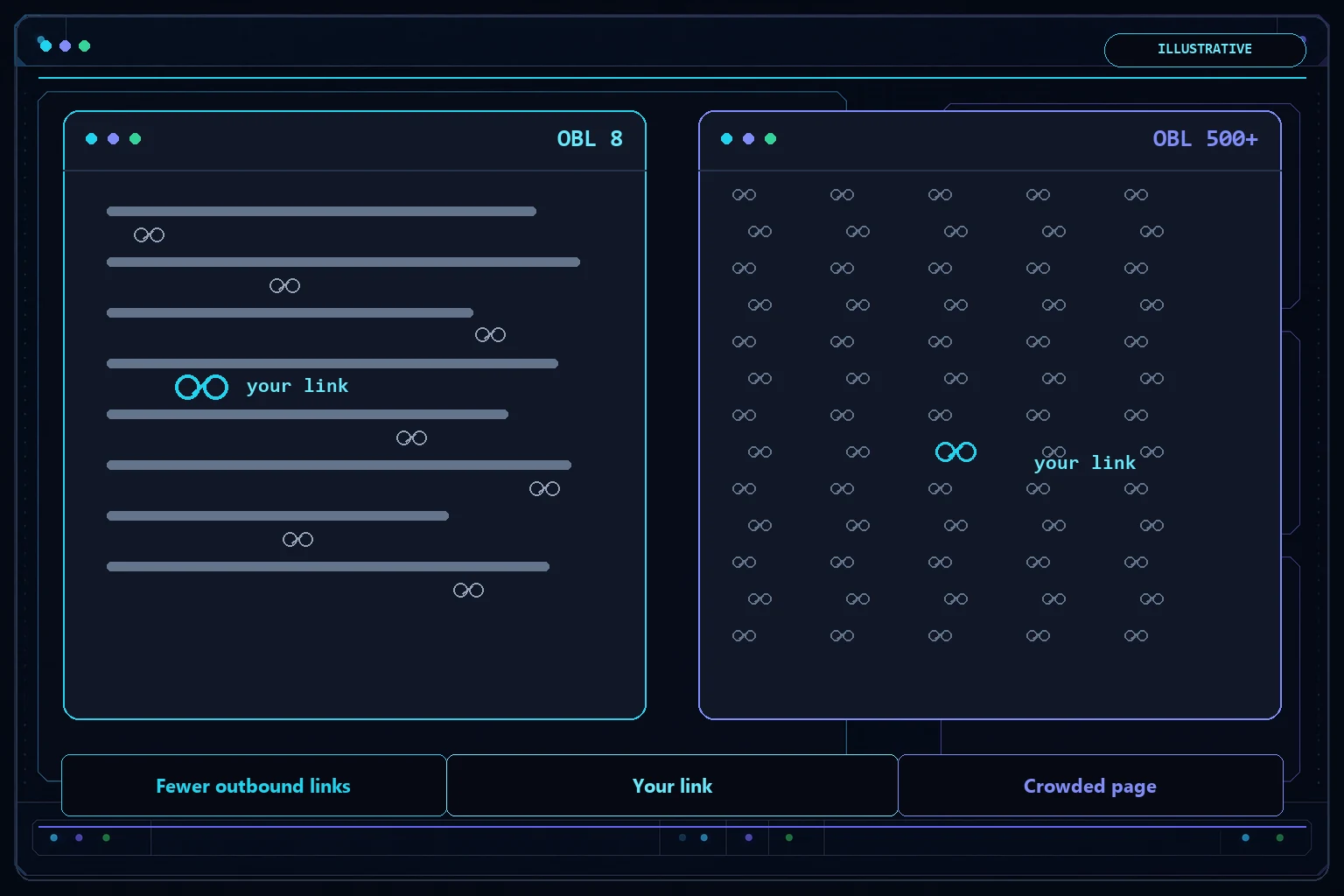
Illustrative diagram comparing the same link on two pages: on a page with eight outbound links it stands out, and on a page with more than 500 outbound links it is lost among them.
THE MECHANISM

Why fewer outbound links can matter

The original PageRank model described a page’s score as being divided among the links leaving it — the more links, the smaller the share each one carries. Google’s systems have moved a long way since that paper, and nobody outside Google can tell you how much of that arithmetic survives. But the underlying intuition — that a page’s endorsement is not infinitely divisible — is why link builders have watched outbound link counts for twenty years.

There is a second reason that has nothing to do with algorithms. OBL is a wear indicator. Pages that accept automated submissions accumulate links the way a guestbook accumulates signatures. A page carrying 700 outbound links has been found, posted to, and re-posted to by every list-runner who came before you. A page with 15 is either fresh, moderated, or hard to post to — all of which make it a more interesting placement. High OBL does not just divide whatever value the page passes; it tells you the target has already been consumed.

Be careful with the claim, though. A low count can correlate with a better placement; it does not cause rankings. Nobody has shown OBL to be a ranking factor Google evaluates by name, and this page will not pretend otherwise. Treat it as a screening signal that removes the worst targets before they cost you resources — not as a lever that moves positions on its own.
THRESHOLDS

What counts as low?

There is no official threshold, so here is the honest version: the number is a trade-off you choose, not a standard you discover.

Outbound linksWhat it means in practice
Under ~25Genuinely uncrowded. Scarce on platforms that accept automated links, because they do not stay at 25 for long.
Under ~50The working ceiling most serious operators use for links they care about. Low enough to exclude burned-out pages while leaving usable volume. It is the ceiling we apply to our own filtered feeds, for exactly that reason.
50–100Tolerable for lower tiers, where the job is volume and the placement page matters less.
Several hundred+The page is a link dump. It may still verify. It is just not worth your submission.

Tighten the ceiling and target volume collapses; loosen it and quality collapses. Anyone selling you a threshold as a magic number is selling the number, not the links.

MEASUREMENT

How to check a page’s OBL

There is no oracle for this — just counting, done manually or automatically.

Manually

Open the page, view source, count href attributes pointing at external domains. Tedious, accurate, and fine for spot-checking a handful of prospects — or auditing a list vendor’s claims.

With SEO tools

Most crawlers report external outlinks per page. Useful when you are evaluating specific sites in quantity rather than one at a time.

Inside GSA SER

The software can filter targets by outgoing links on the page during its run, so URLs over your ceiling are skipped rather than submitted to. The check happens at posting time, on the live page — not on whatever the count was when a list was compiled.

When buying data

You cannot check a million URLs by hand, so the real question becomes when was the OBL measured, and does the vendor re-measure? A ceiling enforced once, at list-build time, decays with every day the list circulates.

That last distinction matters more than the threshold itself, which is why continuous re-verification is the mechanism behind any OBL promise worth trusting.

THE PART OTHERS SKIP

Where the metric misleads

This is the section most pages about OBL leave out, and it is the part that will save you money.

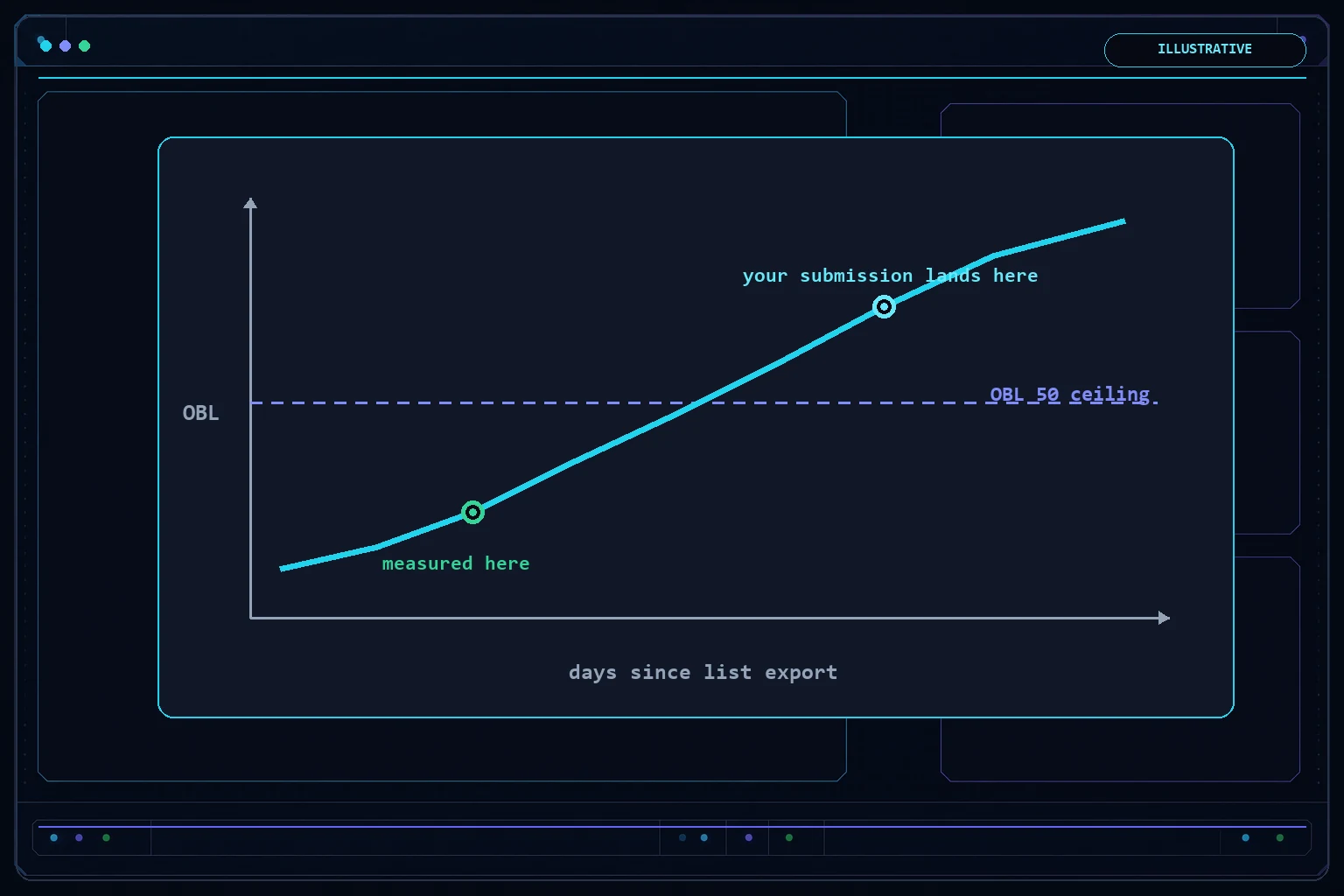
Illustrative chart showing a page’s outbound-link count climbing in the days after a list is exported, crossing an OBL 50 ceiling between the point where it was measured and the point where a later submission lands.

Low OBL does not mean good page

A freshly spun-up junk domain has OBL 3 on every page. It passes any ceiling you set and is still worthless. OBL only sorts crowded from uncrowded; it says nothing about whether the neighbourhood is worth being in. That is why a serious pipeline screens domains against trust metrics and applies an OBL ceiling — either check alone lets rubbish through.

High OBL does not always mean bad page

A well-maintained resource page or an active forum thread can carry a hundred legitimate links. For contextual placements on real sites, judge the page, not just the count.

The number moves — upward

The better a low-OBL target is, the faster other operators’ links push its count up. This is the structural flaw in every static list: its OBL data starts expiring the day it is exported — the same reason people conclude GSA SER stopped working. If your ceiling matters, what you need is the current count, which means the measuring has to keep happening.

Single-metric filtering gets gamed

Any metric buyers filter on, sellers will optimise for. A list advertised purely on OBL can be assembled from low-OBL pages on dead domains, deindexed platforms, or sites that strip links after a week. OBL belongs in a stack, not on a pedestal.

And to say it plainly, because the pages ranking for this term will not: no OBL figure guarantees relevance, authority, indexing, placement quality or rankings. A low count improves the odds that a placement is worth having. Odds are all it improves.

Our live stats exist so you can see a continuously re-measured pool rather than take that on faith.

IN PRACTICE

OBL in GSA SER: how operators actually use it

In GSA Search Engine Ranker the metric turns from theory into a filter you configure.

The blunt instrument is GSA SER’s own outgoing-links filter, which skips any target over your ceiling at posting time. It works, but on raw scraped targets it wastes resources: threads, proxies and captcha solves are spent discovering that most of the internet’s postable pages are already crowded.

The efficient version is to feed GSA SER targets that were already verified and already OBL-filtered, so its threads spend their time posting rather than discarding. That is what a GSA SER low OBL list is for. The evaluation questions for any such list are the ones this page has already given you: what is the ceiling, when was it measured, and is it re-measured — or is the data aging in a file somewhere?

One more honest note, because it cuts against the sales grain: not every tier needs a low-OBL target. Lower tiers exist to push volume at pages you do not care about individually; enforcing a strict ceiling there just shrinks your target pool for no benefit. Save the ceiling for the links that point at things you care about, and let volume be volume below them.

We build our own feeds around exactly that split — four category feeds filtered to OBL < 50, plus one deliberately unfiltered volume pool — because the metric earns its keep at the top of a structure, not the bottom.

If you are here for the list

Fair enough — the theory is above if you ever want it. GSA Link Surge supplies continuously re-verified GSA SER targets through five private feeds: four category feeds filtered to OBL < 50 at verification time and re-checked as pages change, plus an unfiltered 30-day pool for volume tiers. At least 400,000 verified targets per month across the inventory, with current pool counts published daily on the live stats page. Setup is a single file in GSA SER — the setup guide shows the whole process — and every plan carries a seven-day money-back guarantee. Plans are on the pricing page.

FAQ

OBL questions

What is OBL in SEO?

OBL stands for outbound links — the number of links on a page that point to external websites. In link building it describes the page where your backlink is placed: a low-OBL page shares its endorsement among few links, a high-OBL page among many. Some tools call the same count “outgoing links”.

What counts as a low OBL?

There is no official standard. In practice, under about 25 is genuinely uncrowded, a ceiling around 50 is the common working threshold for links pointing at pages you care about, and counts in the hundreds indicate a page that has been posted to heavily. The right ceiling is a trade-off between placement quality and available volume, not a fixed number.

How do I check a page’s OBL?

Manually: view the page source and count links to external domains. At scale: site crawlers report external outlinks per page, and GSA Search Engine Ranker can skip targets over a chosen outgoing-links ceiling during a run. When buying list data, ask when the OBL was measured and whether it is re-measured — a count taken months ago describes a page that no longer exists.

How important is it that a backlink has few OBL?

It matters as a screening signal, not as a ranking lever. A low count means a less crowded placement and usually a less exhausted target, which improves the odds the link is worth having. It does not make a bad page good, and it guarantees nothing about rankings or indexing. Weight it alongside platform type, domain quality and relevance — not instead of them.

Is OBL a Google ranking factor?

Not as a named, documented factor. The reasoning behind the metric traces back to the original PageRank model, where a page’s score was divided among its outbound links, but modern ranking systems are far more complex and Google does not publish anything called OBL. Treat it as an operator’s heuristic with a plausible mechanism — useful for filtering, wrong to treat as a guarantee.

How do I find low OBL sites for GSA SER?

Three routes: scrape targets yourself and let GSA SER’s outgoing-links filter discard crowded pages at posting time (this works, but burns threads, proxies and captcha solves on discovery); spot-check and compile targets manually (accurate, does not scale); or use a maintained list or feed that applies the OBL ceiling before targets ever reach GSA SER. Whichever route you take, the freshness of the OBL measurement matters more than the ceiling itself.

Does GSA Link Surge filter every feed to OBL < 50?

Four of its five feeds, yes — filtered at verification time and re-checked continuously as pages change. The fifth, the 30-Day Surge Pool, is deliberately unfiltered: it is the complete verified pool for volume tiers, where a strict ceiling costs more than it returns. The split is intentional. Details on the verified list page.

Filter on a ceiling that is actually enforced

Continuously re-verified GSA SER targets, with OBL < 50 on the four category feeds.

Start Surging →
7-day money-back guarantee · See what the feeds include
⚡ Start Surging — Low-OBL verified links from $47/mo