Do Backlinks Still Matter in 2026?Yes. But the Strategy Changed.
AI didn't kill backlinks. It doubled the reason to build them — and made how you build them matter more than ever.

- 4Private SurgeFeeds
- OBL < 50Quality filter
- 400,000+Verified unique-domain targets monthly*
- LiveContinuously re-verified
*Minimum expected monthly delivery. Actual volume varies with daily scraping and verification performance.
Reviewed by GSA Link Surge · Updated August 4, 2026
Do backlinks still matter?
Yes. Google still uses link analysis to understand authority and relevance, while AI search features rely on the same core search foundations. Backlinks remain one signal alongside useful content, crawlability, relevance and page experience. The strategy matters as much as the volume.
What actually changed
Google started putting AI Overviews at the top of some results. ChatGPT, Perplexity and Gemini answer some questions outright. So the worry spread: if nobody clicks through, why build links?
Start with that premise, because it's shakier than it sounds. An AI Overview sits above the classic results — it didn't delete them. Scroll past the summary and the blue links are still there, still ranked, still getting clicked. And for whole classes of search the overview either doesn't show or nobody stops at it: brand names, specific tools and software, comparisons, pricing, local, and most transactional queries still send people straight into the organic listings. When someone is choosing a product or hunting a real page, a summary isn't what they came for.
So the honest version isn't "the SERP died." It's that a second layer got added on top of it — and you now have to win in both places.
And the part the "SEO is dead" crowd misses: answer engines don't invent authority — they borrow it. They surface and cite pages that search engines already trust. And the thing that still earns that trust is links from relevant, credible sources.
Why backlinks still decide everything
Strip away the tactics and search comes down to one question the engine is always asking: who else vouches for this page? A link is that vote. A page with relevant, credible sites pointing at it reads as trusted. A page with none reads as unproven — no matter how good the content is.
That hasn't softened; it's sharpened. As AI-generated content floods the web, links from real, established sources are one of the few signals that are genuinely hard to fake at scale. They're proof that something in the real world referred to you.
Stop building them and the decay is quiet but certain: competitors who keep pointing authority at their pages drift past you, and by the time you feel it in the rankings, you're months behind.
Why serious operators build in tiers
Ten thousand automated links fired straight at your money site is the fastest route to a penalty. The same ten thousand links, structured correctly, become rocket fuel. The difference is tiering.
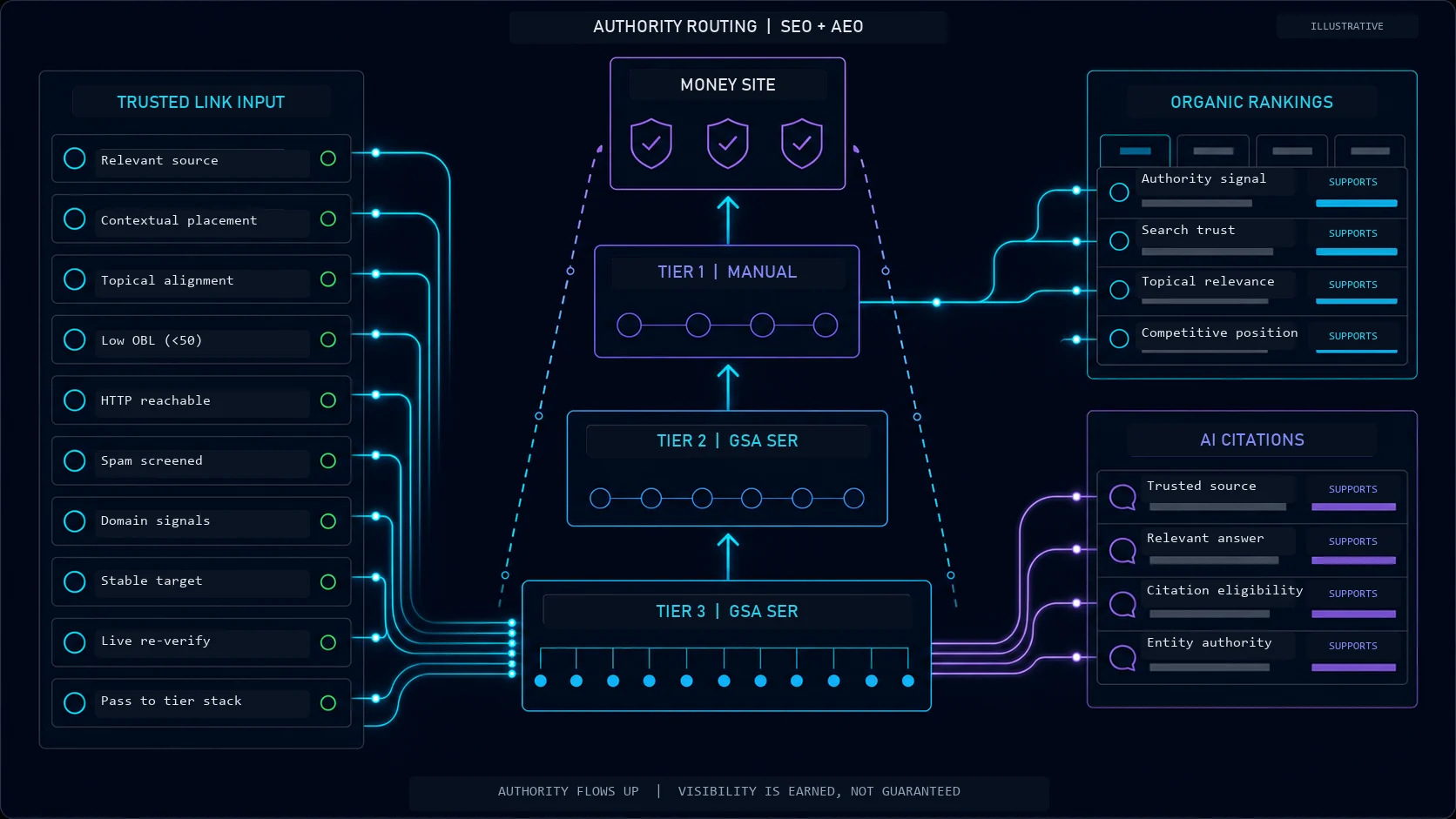
Picture a pyramid. Tier 1 sits directly below your money site — a small number of strong, clean, contextual links that pass real authority to it. Tier 2 points at your Tier 1 links, strengthening them. Tier 3 points at Tier 2 — a widening base of volume that amplifies everything above it.
Authority flows up the pyramid. Each layer boosts the one above, so the raw power of thousands of automated links reaches your money site indirectly — filtered, diluted, and safe — instead of hitting it head-on.
Hand-build Tier 1 on permanent assets.
Automate Tier 2 & 3 with GSA SER.
This one rule separates operators who rank for years from the ones who get burned every few months.
Build Tier 1 by hand — and make it permanent
The links touching your money site directly are the ones that can hurt you. So they should be permanent, hand-placed assets: guest posts on real sites, contextual niche edits, Web 2.0 properties you own and control. You place them deliberately, and they stay.
Why manual and permanent? Because a Tier 1 link that vanishes or turns spammy doesn't just stop helping — it can actively drag your money site down. Rented links get pulled. Cheap automated links pointed straight at your site get flagged. Permanent assets you control don't break. That stability is the whole foundation your rankings stand on.
Automate everything below it
Tier 2 and Tier 3 are where automation earns its keep — and this is GSA Search Engine Ranker territory. Here you want volume, speed, and churn. It doesn't matter if some of these links come and go, because they point at your Tier 1 buffer, never at your money site directly.
That's the payoff of the structure: you get the full power of scaled, automated link building, with none of the exposure. Your foundation stays hand-built and stable; the power underneath it runs at machine scale.
A practical operating sequence
- 1Build Tier 1 manually
Use permanent assets you select and control.
- 2Use GSA SER for lower tiers
Apply automation where scale and churn belong.
- 3Keep verified targets current
Supply each run with continuously re-verified feeds.
GSA SER does the work. We keep it fed with clean targets.
For Tier 2, Tier 3, and the volume that makes tiering work, nothing beats GSA Search Engine Ranker. It lets one operator place links at a scale a whole team couldn't touch by hand.
But an engine is only as good as its fuel — and GSA SER lives or dies on the targets you feed it. That's exactly where most setups fall apart now. Public scraping has been throttled to death, and the shared lists everyone buys are mostly dead links that every other user is already hammering. Feed GSA SER burned targets and you waste threads, proxies and captcha credits posting to endpoints that never land.
GSA Link Surge is the fuel. A live feed of continuously re-verified, low-OBL (<50), contextual-first targets — delivered straight into GSA SER, current on every run. Your automated tiers stay clean and effective instead of spammy and dead. You build the safe, powerful pyramid — permanent Tier 1, GSA-driven Tier 2 and 3 — without babysitting stale lists.
And now, links decide AI citations too
When an answer engine picks sources, it leans on signals of trust and relevance. A page with authority earned through real links is far more likely to be quoted, linked or summarized than an identical page with none. That's the core of AEO and GEO — answer engine and generative engine optimization — and it runs on the same fuel as classic SEO.
Backlink strategy questions
Straight answers for GSA SER operators planning lower-tier campaigns.
Do backlinks still matter for SEO in 2026?
Yes. Search engines still use links to understand relationships, relevance and authority across the web. Backlinks work alongside useful content, technical accessibility and a strong page experience rather than replacing them.
Do backlinks help with AI-search visibility?
Links can support the authority and discoverability signals used across search, including AI-assisted search experiences. They can improve the foundation, but no link provider can guarantee a citation or a specific ranking.
Is tiered link building completely safe?
No link-building method is risk-free. If you are beginning, we highly recommend building Tier 1 manually and using GSA SER for lower tiers according to your own risk tolerance.
Should I point GSA SER links directly at a money site?
For beginners, we recommend keeping the links that touch a money site manually controlled. GSA SER is better suited to Tier 2 and Tier 3 campaigns that support assets below your money site.
What does OBL mean in link building?
OBL means outbound links: the links a page sends to other websites. A lower OBL count can reduce authority dilution, but relevance, placement and the quality of the linking page still matter.
Keep earning authority. Both games.
Permanent Tier 1 by hand. Clean, low-OBL Tier 2 and 3 through GSA SER — fed live by GSA Link Surge.